Discover to classify
Capture the use case, owner, workflow, data classes, model/provider assumptions, tool needs, autonomy level, user group, and trust boundary before the AI worker moves toward operation.
Security
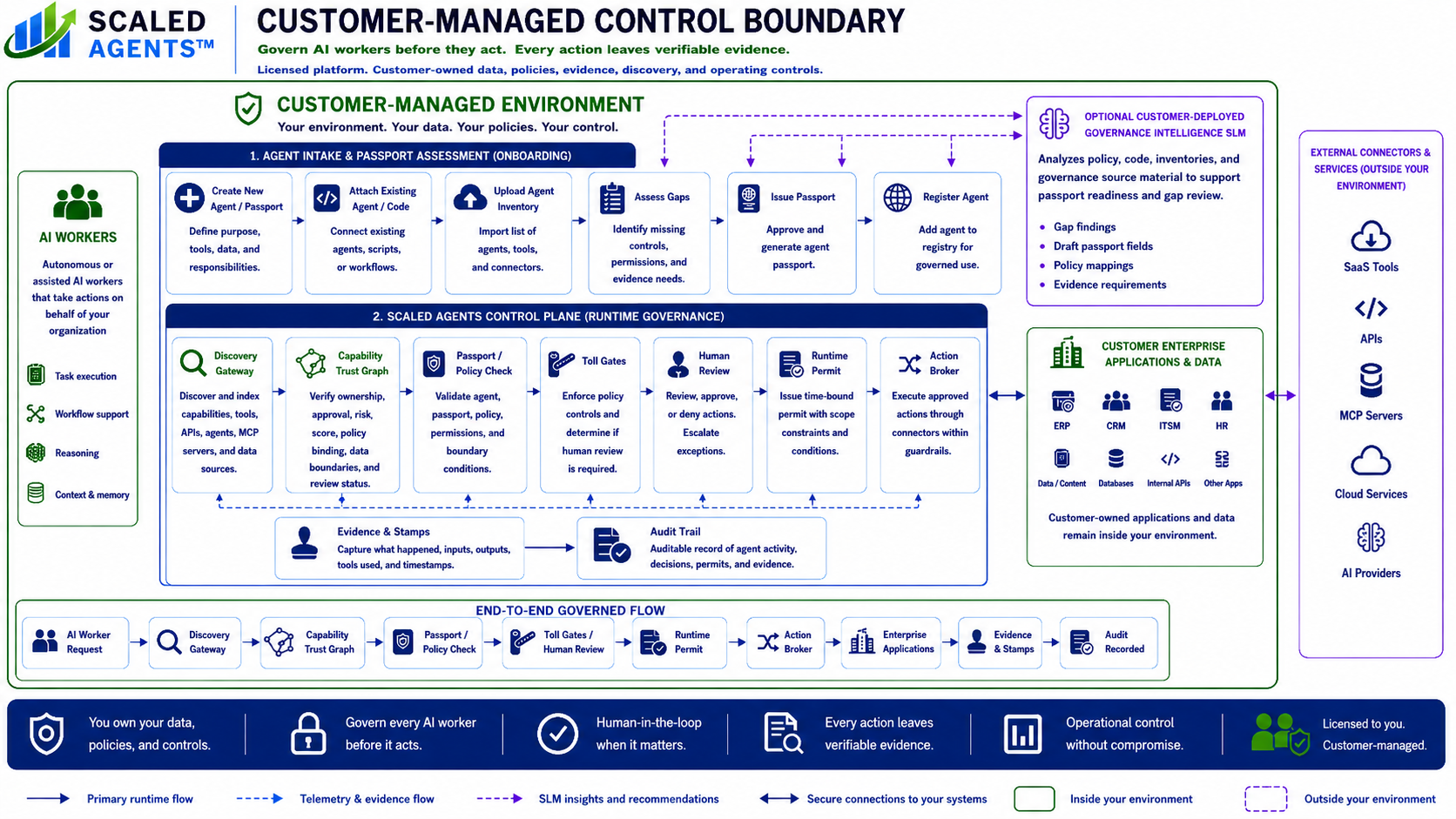
Scaled Agents™ frames security as a supporting trust layer inside the governed AI worker operating model: identity, least privilege, data minimization, human approval, evidence, monitoring, runtime authorization, and safe operating boundaries before AI-supported work becomes consequential action. Each AI worker should have a Passport-backed operating record for owner, purpose, scope, permissions, lifecycle state, evidence trail, review path, and escalation boundary.
Context
Security planning should clarify what the AI worker may access, who owns the operating record, which actions require review, and what evidence must exist before the work moves closer to tools, systems, data, or external commitments.
Scaled Agents is a licensed, customer-managed AI Worker Control Plane for governing AI workers through ownership, approved scope, review gates, evidence, and lifecycle visibility.
AI Security Architecture
Scaled Agents™ organizes AI security architecture around governed AI worker records: Discover, Register, Classify, Assess, Approve, Deploy, Authorize, Monitor, Audit, and Improve. This lifecycle helps teams connect use cases, data boundaries, prompt and retrieval controls, Model & Provider Dependency Records, tool permissions, runtime decisions, monitoring, incident paths, and evidence without treating a draft record as approval.
Capture the use case, owner, workflow, data classes, model/provider assumptions, tool needs, autonomy level, user group, and trust boundary before the AI worker moves toward operation.
Review prompt behavior, RAG or vector sources, data lineage, connector permissions, threat themes, required Toll Gates, human approval, evidence gaps, and rollback or pause conditions.
Use Runtime Permit, Action Broker, Toll Gate, Human Review, Evidence Record, Workflow Event, and Audit Export records to show what was requested, checked, blocked, escalated, or approved for review.
Use NIST AI RMF and NIST CSF 2.0 as anchor lenses, then extend to ISO/IEC 42001, OWASP Agentic AI, MITRE ATLAS, CISA Secure-by-Design, EU AI Act, and ENISA themes where relevant.
Summarize posture, incident trajectory, exposure-adjusted monitoring, overdue reviews, blocked actions, and evidence gaps without converting dashboard signals into formal approval or assurance.
Stabilize Passport fields and evidence records first, then expose reviewer fields in Passport Studio, then refine public messaging after the record model remains consistent.
This public summary supports readiness conversations and evidence organization. It does not certify compliance, validate security posture, approve production use, provide legal advice, or replace customer security, privacy, compliance, audit, and operational review.
Security Principles
Scaled Agents™ security guidance is centered on governed access, bounded autonomy, traceable decisions, and human accountability. The goal is to help teams understand what must be reviewed before AI workers interact with sensitive data, tools, systems, workflows, or external commitments. Security, identity, cloud, SaaS, model-provider, API, workflow, and MCP-compatible controls remain connected systems around this governance-planning model; public pages do not claim those controls are already implemented by Scaled Agents in a customer environment. These materials support education and preparation, not certification.
AI workers should have defined identities, owners, scopes, permissions, lifecycle states, and review paths. Access should be limited to the reviewed purpose and removed when no longer needed.
Requests should use only the data needed for the reviewed purpose. Secrets, credentials, regulated data, and unrelated sensitive material should not be placed into public or preview workflows.
Material AI worker activity should leave reviewable evidence showing what was proposed, what was checked, what required approval, what can be summarized for customers, and what remains owner-only.
Higher-risk requests should be evaluated before action against Passport scope, tool permission, data boundary metadata, cost and usage expectations, approval status, and evidence readiness.
Knowledge access should be planned so sensitive labels, chunk permissions, user attributes, and environment context are checked before retrieved context reaches an AI worker.
Security planning should define who can pause, restrict, disable, revoke, contain, restart, or reapprove an AI worker when behavior or context leaves the reviewed boundary.
Resource consumption, repeated retries, unexpected tool chains, and cost anomalies should be treated as governance signals that may require evidence, human approval, or containment.
Scaled Agents™ Security
AI agents do more than generate responses. They use tools, access data, trigger workflows, write memory, and hand work to other systems. This page shows a governance-control concept for planning and review around those actions so teams can evaluate an AI worker against an owner, a Passport record, approved boundaries, lifecycle state, evidence trails, review path, escalation boundary, and a revocation path before consequential use.
The model generates intelligence. The preview control fabric shows how governed action can be reviewed.
Control outcomes
A preview governance record for each AI worker, including owner, purpose, scope, permissions, lifecycle state, control references, evidence summary, approval state, exception state, and review status. The Passport concept defines reviewed authority boundaries; customer implementation still requires environment-specific controls and validation.
A preview inventory model for proposed, reviewed, active, restricted, suspended, and retired agents with risk tier, access boundary, model/provider summary, tool permissions, data classification, and human owner.
Structured evidence records and example review markers for approvals, reviews, policy checks, access decisions, and runtime-governance planning.
Human review checkpoints and planned automated checkpoints that can be configured before agents perform sensitive, high-impact, or regulated actions.
AI Worker Security
An AI worker may draft, recommend, route, call tools, or support workflows. Security review should consider the requested action, data class, target system, authority boundary, human review requirement, rollback path, and audit evidence.
Runtime Security Controls
For governed AI workers, the security question is not only whether a model is allowed. It is whether this AI worker, with this identity, owner, Passport scope, data boundary, tool permission, cost expectation, evidence set, and approval state should be allowed to perform a proposed action in a reviewed customer implementation.
Plan for each AI worker to have an operating identity, owner, workload identity assumptions, approved authority roles, and revocation path. A Passport reference is not a credential or access grant.
Use classifications, approved sources, destination classes, chunk-level permission metadata, redaction status, retention posture, and connector boundaries so sensitive context does not move without review.
Plan retrieval so unauthorized users receive no restricted context, instead of relying on a model to redact or refuse after sensitive context has already been assembled.
Use canary-style validation scenarios to confirm restricted knowledge is not returned for unauthorized test users. Any positive recall should route to remediation before wider use.
Preserve policy version, behavior profile version, model/provider reference, tool reference, decision trace, review path, drift signal, containment status, and closure notes where applicable.
Track model-route scorecard evidence, eval queue status, human review, rollback route, and total task cost per successful outcome before any future route promotion. This is governance support, not live provider routing or production approval.
Require process evidence for persuasive, executive-framed, BEC-style, voice/video-confirmed, or multi-channel requests before payment, access, external communication, credential, or workflow-change action.
Operating Review
A recurring operating review gives teams a governed view of AI workers: what remains within reviewed scope, what needs review, what changed, and what evidence is available for accountability.
Boundaries
High-level security posture, least privilege, identity-centric access, data boundaries, human approval, evidence, and readiness expectations for governed AI workers.
Identity, access control, tenant isolation, logging, secure artifact storage, production controls, and deployment architecture must be reviewed for each customer environment. Users should seek qualified legal review and qualified expert review before relying on customer-specific security, privacy, or compliance documents.
No legal advice, regulatory conclusion, compliance accreditation, security attestation, formal audit opinion, production use, or customer risk acceptance is claimed.