Knowledge and analysis
Research, compare, classify, summarize, or prepare recommendations from approved sources.
Human decision: validate the evidence, interpretation, and resulting choice.

AI Worker Roles & Patterns
Choose a clear work pattern, name accountable human owners, and define the boundary between AI-supported work and human decision rights.
AI Workers are governed digital capabilities. They are not employees, legal actors, accountable owners, or final approvers.
Start With The Work
Research, compare, classify, summarize, or prepare recommendations from approved sources.
Human decision: validate the evidence, interpretation, and resulting choice.
Prepare intake, route work, monitor status, identify gaps, or coordinate governed handoffs.
Human decision: own priorities, exceptions, escalation, and completion.
Request a specific tool or system action within explicit data, destination, and permission boundaries.
Human decision: approve consequential paths and retain pause, revoke, and recovery authority.
Governed Handoff
The role name describes intended work. It does not grant access, approve a Passport, lower risk, issue runtime authority, or replace accountable review.
Next Step
Capture the business outcome, owner, pattern, audience, data, tools, autonomy, risk, review path, monitoring, and escalation requirements.
The role catalog helps teams decide which AI Workers should support business, technology, security, data, operations, executive, legal, audit, assurance, insurance, marketing, sales, and delivery workflows.
Context
This page explains the human and AI Worker role model before a team designs, registers, or scales an AI Worker. Use it to clarify the difference between AI-supported work and accountable human decision rights.
Which AI Worker role family fits the workflow, which human co-partners must be named, and which review responsibilities should be visible before a Passport or Blueprint moves forward.
AI Workers can draft, classify, summarize, route, monitor, and prepare evidence. Human owners remain accountable for scope, approvals, risk acceptance, exceptions, and consequential action.
This catalog is planning guidance. It does not approve an AI Worker, grant access, authorize production use, or replace legal, compliance, security, privacy, audit, or owner review.
Roles And Responsibilities
The model is intentionally role-based. A single organization may combine several human roles, but the governance record should still distinguish business accountability, technical operation, risk review, data ownership, validation, escalation, pause authority, and lifecycle decisions.
AI Workers support defined work within a controlled scope. Their outputs should be treated as drafts, recommendations, summaries, classifications, routing suggestions, tests, or evidence preparation unless a separately approved process says otherwise.
Human co-partners own the decision rights around the AI Worker. They validate outputs, approve scope, accept or reject recommendations, manage exceptions, and remain accountable for the business, technical, risk, and data context.
An AI Worker must not approve its own work or scope, expand its own authority, bypass review, accept residual risk, create credentials, conceal failures, or turn a draft Blueprint into production authorization.
Legal, audit, assurance, privacy, finance, insurance, security, customer-impacting, employee-impacting, production, and external communications workflows require stronger review, evidence, and approval gates.
Organization Chart
Use this chart as a public-page visual for explaining how executive governance, accountable human roles, and AI Worker families fit together. The chart is not an approval model by itself; it is a planning aid for assigning ownership and review paths.
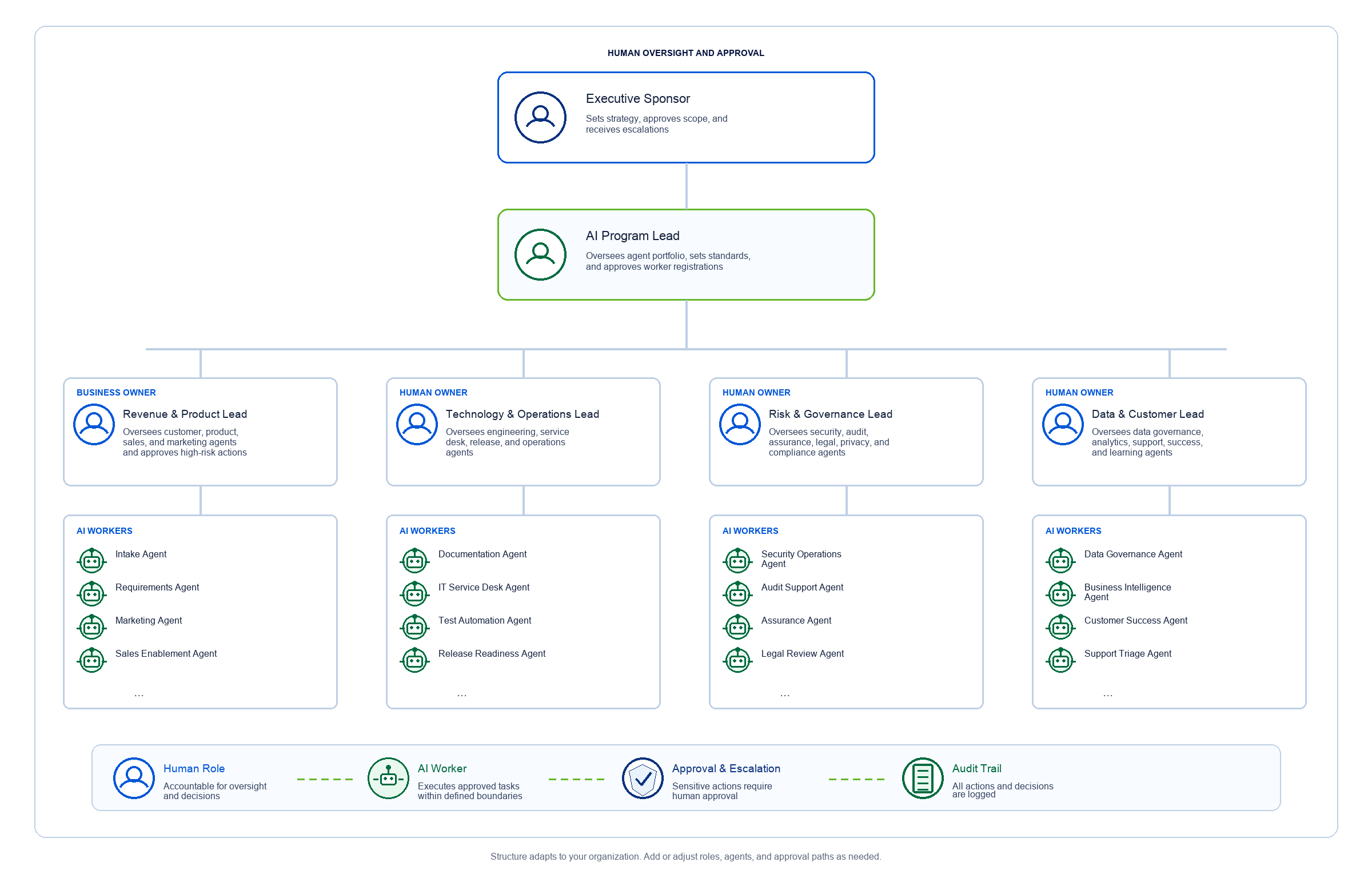
AI Worker Families
The downloadable Excel catalog contains the full table of AI Worker role patterns, human co-partners, responsibilities, capabilities, expertise level, risk level, and confidence level. The public page summarizes the major families, including the foundation role used to design the AI workforce layer before build.
Support pre-build AI workforce design by converting business intent into governed agent architecture, approval paths, evidence needs, and registry handoff.
Support intake, requirements, product strategy, customer success, sales, marketing, communications, and training workflows.
Support documentation, IT service desk, test automation, release readiness, engineering delivery, solution design, platform engineering, and cloud architecture.
Support security operations, security review, vulnerability management, identity governance, technology risk, audit, assurance, compliance, and legal review.
Support data governance, data pipeline review, business intelligence, model governance, privacy technology, analytics, and data quality checks.
Support runtime support, incident response, operations optimization, resilience planning, support triage, IT asset tracking, and continuity preparation.
Support executive strategy, board briefing, finance analysis, enterprise risk, procurement, insurance review, and vendor technology review.
Foundation Agent
The AI Architect Agent turns a business use case into a governed agent architecture before implementation. It designs agent responsibilities, workflow steps, tool/API/MCP planning boundaries, system and data access, approval gates, evidence requirements, observability, evaluation, and registry handoff. It does not design the base AI infrastructure layer, configure live systems, or approve production use.
Produces a review-ready canvas with agent pattern, workflow design, owners, approval gates, risk classification, monitoring, evaluation, audit, and open questions.
Prepares draft Agent Workforce Registry details for human review, including lifecycle state, approved inputs and outputs, tool boundaries, prohibited uses, and evidence references.
Requires review before build handoff, live tool or MCP use, customer-impacting recommendations, external communications, production-adjacent workflows, or consequential action.
Foundation Agent rule: architecture recommendations remain planning outputs until the required human owners review the canvas, registry handoff, Passport scope, Toll Gates, evidence, and implementation path.
Expert Role Coverage
These role patterns should be represented as AI Worker templates, aliases, or review lanes in the catalog. They remain support roles under human ownership, Passport scope, Toll Gates, evidence, and review boundaries.
| Expert Role Pattern | Scaled Agents Worker List Name | Human Co-Partner / Review Boundary |
|---|---|---|
| Forward Deployed Engineer | Forward-Deployed AI Engineering Agent | Delivery owner reviews customer-context adaptation, implementation assumptions, and release-readiness routing. |
| AI Engineer | AI Engineering Support Agent | Technical owner reviews implementation plans before code, runtime, connector, or deployment work proceeds. |
| AI Evals Engineer | AI Evals Agent | Evaluation owner reviews test coverage, quality thresholds, drift signals, and domain validation needs. |
| Context Engineer | Context Engineering Agent | Knowledge and data owners review source boundaries, retrieval scope, prompt context, and sensitive-data controls. |
| AI Agent Architect | AI Architect Agent | Architecture governance owner reviews the Agent Architecture Canvas before build or registry handoff. |
| Chief AI Officer | AI Strategy and Governance Executive Support Agent | Human executive sponsor remains accountable for strategy, priority, funding, and final decisions. |
| AI Governance and Ethics Lead | AI Governance and Ethics Agent | Governance owner reviews responsible-use boundaries, accountability, policy gaps, and review paths. |
| AI Enablement Lead | AI Enablement Agent | Training or enablement owner reviews adoption materials, role guidance, and learner-facing claims. |
| AI Red Team Engineer | AI Red Team Agent | Security owner authorizes any adversarial testing and reviews misuse, prompt-injection, and containment findings. |
| Decision Engineer | Decision Engineering Agent | Policy and business owners review decision logic, escalation points, and consequential-action boundaries. |
| AI Consultant and Strategist | AI Consultant and Strategy Agent | Business owner reviews opportunity framing, operating assumptions, roadmap recommendations, and commitments. |
| AI Product Manager | AI Product Manager Agent | Product owner reviews PRDs, prioritization, launch readiness, and customer-facing promises. |
| Agent Supervisor | Agent Operations Monitoring Agent | Operations owner reviews status, lifecycle, queue, and escalation signals; AI does not manage people. |
| AI Trainer and Data Annotator | AI Trainer and Data Annotation Agent | Training and data owners review annotation quality, approved data use, and learner/data boundaries. |
| Conversation Designer | Conversation Design Agent | UX, product, legal, and security reviewers validate customer-facing flows, fallbacks, and escalation language. |
| Human-Agent Workforce Lead | Human-Agent Workforce Design Agent | Operating-model owner reviews RACI, training needs, workflow fit, and human accountability assignments. |
| AI Legal and Policy Counsel | Legal and Policy Review Support Agent | Qualified human reviewer or counsel reviews legal and policy outputs; the AI role does not provide legal advice. |
| AI-Augmented Sales and GTM Specialist | AI-Augmented Sales and GTM Agent | Sales, marketing, and legal reviewers validate GTM messaging, claim boundaries, and customer commitments. |
| AI Customer Success Manager | AI Customer Success Agent | Customer success owner reviews onboarding, renewal risk, support routing, and service-level commitments. |
| AI Auditor and Assurance Lead | AI Audit and Assurance Agent | Audit or assurance owner reviews evidence packages; AI does not issue audit opinions or compliance conclusions. |
Catalog rule: represent these as governed worker patterns and aliases first. Do not treat any role name as employment status, professional license, legal authority, audit authority, security authorization, or production approval.
Detailed Role Table
Use this table to start role design before a Passport is drafted. Final assignments should be validated against the customer environment, data classes, tool access, review path, and risk tier.
| Human Co-Partner | AI Agent Role | Primary Responsibility | Typical Capabilities | Level of Expertise | Risk Level | Confidence Level |
|---|---|---|---|---|---|---|
| Executive sponsor | Strategy Briefing Worker | Prepare executive-ready summaries, options, assumptions, and decision context. | Summarize roadmap inputs, surface risks, compare options, draft briefing packs. | Advanced business context | Medium | Medium when sources are verified |
| Architecture governance owner | AI Architect Agent | Design governed agentic workflows before build, deployment, or production-adjacent use. | Select assistant, single-agent, multi-agent, or human-in-the-loop pattern; draft Agent Architecture Canvas; map tools, APIs, MCP, data, systems, approvals, evidence, observability, evaluation, and registry handoff. | Advanced agentic architecture and governance workflow design | High | High for review-ready architecture when inputs, systems, owners, and constraints are provided; lower when integration or risk details are unknown |
| Product owner | Product Discovery Worker | Translate customer problems into draft opportunities, use cases, and acceptance criteria. | Cluster feedback, draft user stories, map assumptions, prepare experiment notes. | Intermediate product workflow | Medium | Medium; requires owner validation |
| Engineering lead | Engineering Delivery Worker | Support technical planning, documentation, testing notes, and release-readiness preparation. | Draft technical notes, identify dependencies, prepare test scenarios, summarize defects. | Advanced technical context | High | Medium; no production change authority |
| Security owner | Security Triage Worker | Prepare security review packages and route findings for accountable human review. | Summarize vulnerabilities, map controls, classify severity drafts, prepare remediation evidence. | Advanced security workflow | High | Medium; requires security review |
| Data owner | Data Governance Worker | Support data classification, lineage questions, quality notes, and access-boundary review. | Draft data inventories, flag missing owners, prepare retention and source-control prompts. | Intermediate to advanced data governance | High | Medium when data sources are authorized |
| Operations lead | Operations Readiness Worker | Prepare workflow readiness, handoff, support, incident, and lifecycle review materials. | Draft SOPs, route support requests, summarize incidents, prepare readiness checklists. | Intermediate operations context | Medium | High for low-impact support workflows |
| Legal or compliance reviewer | Policy Review Support Worker | Organize policy questions, evidence gaps, and review packets without making legal conclusions. | Summarize clauses, identify missing evidence, draft review notes, route exceptions. | Advanced review workflow | High | Low to medium; professional review required |
| Training manager | Enablement Worker | Prepare learner paths, training summaries, role guidance, and knowledge-check drafts. | Draft course outlines, map roles to training, prepare quizzes, summarize completion gaps. | Intermediate enablement context | Low | High when content is reviewed |
Detailed role records should feed the Passport owner profile, approved scope, allowed and prohibited actions, Toll Gates, evidence requirements, and human review path.
RACI Baseline
AI Workers can be Responsible for preparing support work, but humans should remain Accountable for approvals and outcomes. The full workbook includes a larger RACI guide.
| Activity | AI Worker | Human Co-Partner | Business Owner | Risk / Security / Legal | Platform / IT Owner |
|---|---|---|---|---|---|
| Define business problem | Responsible | Accountable | Consulted | Informed | Informed |
| Draft requirements or Blueprint | Responsible | Accountable | Consulted | Consulted | Informed |
| Assess risk tier | Responsible | Consulted | Consulted | Accountable | Consulted |
| Approve agent scope | Informed | Consulted | Accountable | Consulted | Consulted |
| Approve data or system access | Informed | Consulted | Consulted | Consulted | Accountable |
| Execute low-risk approved support tasks | Responsible | Accountable | Informed | Informed | Consulted |
| Approve consequential action | Informed | Consulted | Accountable | Consulted | Consulted |
| Write evidence record or activity trail | Responsible | Accountable | Consulted | Consulted | Informed |
RACI rule: AI Workers can help prepare the work; human owners approve, reject, remediate, escalate, pause, or retire the governed path.
Controls
The operating model should capture enough context to show who owns the worker, what it may do, what it must not do, what evidence exists, and what requires review before the worker can operate at greater scale.
Records governed identity, owner, purpose, scope, permissions, lifecycle state, review status, and evidence links.
Define review or authorization points for data, tools, cost, autonomy, external communication, or consequential action.
Capture evidence markers for reviews, denials, approvals, lifecycle events, exceptions, remediation, and outcomes.
Preserves accountable decision workflows for approval, denial, escalation, exception handling, and remediation.
Represents short-lived, scoped authority for a specific proposed action after current identity, purpose, policy, evidence, and review conditions are checked.
Mediates approved execution requests against current permissions and prohibited actions; a prior approval or active Passport does not authorize every action.
The Excel workbook includes the full role table, summary, RACI guide, and control legend. It is intended for planning and review conversations, not as an approval record or production authorization.