Readiness layer
Public-safe planning content. Readiness templates, Advisor outputs, and Blueprint drafts help teams prepare review conversations. They do not approve production use.
Governed AI Worker Operating Layer
Scaled Agents™ helps organizations govern AI workers before they act across tools, data, systems, and workflows. Start with a draft Blueprint, then map ownership, purpose, scope, permissions, risk tier, controls, approval path, evidence, lifecycle state, and next steps before implementation or production decisions.

Operating Model
Scaled Agents connects AI worker intake, ownership, policy review, runtime gates, execution evidence, and lifecycle visibility into one governed operating model. Teams can see who owns the worker, what it may do, where review is needed, when work should pause or escalate, and which evidence supports the current status.
The Agent Passport defines identity, owner, approved scope, and review posture. Runtime authorization applies those boundaries at action time before higher-risk work proceeds, while replay-safe evidence helps preserve review context and decision history.
The post-launch question is operational accountability: who owns the AI worker after launch, who can change or pause its authority, how exceptions are reviewed, and how value, cost, quality, and control evidence stay current before wider scale.
The release-candidate story is simple: Passport sets the standing authority, runtime authorization checks the specific request, human review handles higher-risk or unclear movement, and execution receipts preserve what was reviewed, blocked, allowed, or escalated.
For a step-by-step view, see how a governed workflow moves from intake to reviewed next steps.
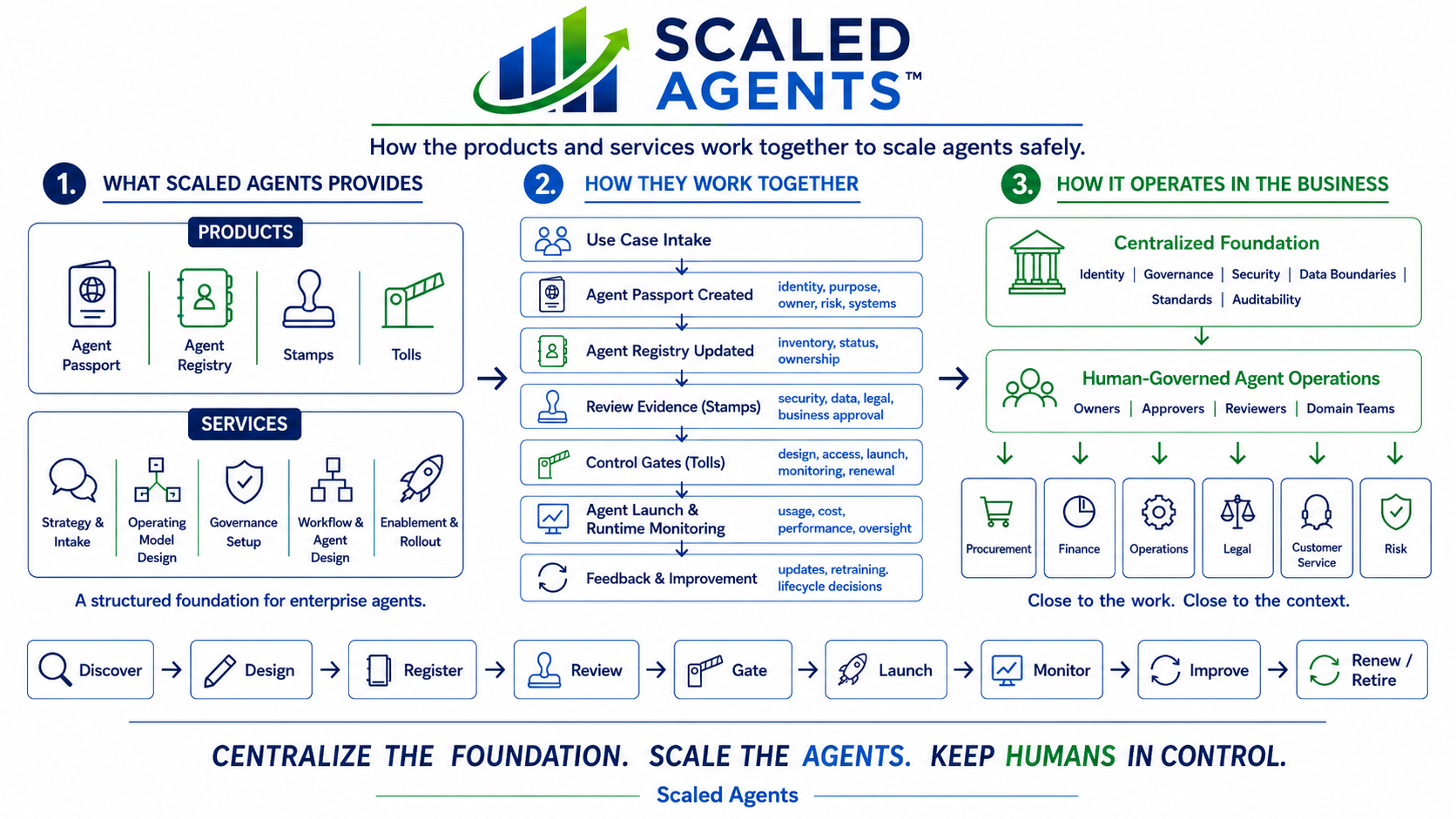
Scaled Agents gives teams a governed operating model for AI workers: who owns them, what they may do, what needs review, and what evidence supports the current status.
Step 1 in the image separates what Scaled Agents provides into Products and Services. Products create the reusable governance records; services help teams design, set up, and roll out the operating model.
Step 2 in the image shows the operating sequence from intake through improvement. Each row creates or updates governance context so the AI worker is visible before it moves closer to use.
Step 3 in the image shows the business operating model: a centralized foundation connected to human-governed agent operations, then applied close to the work across business functions.
Use the Readiness Advisor to understand where an AI worker idea fits, what review may be needed, and what next step is appropriate before relying on a draft blueprint or recommendation.
Readiness-focused. Human-reviewed. Designed to support accountable AI worker operations without claiming legal, security, compliance, audit, or production use.
Stack Position
Scaled Agents sits in the AI worker governance control-plane layer: between standing authority and operational action. It helps teams connect Passport scope, Toll Gates, evidence, policy version, human review, runtime authorization, and lifecycle state before higher-risk AI-supported work moves forward.
Governance readiness explains what should be true. Observability explains what happened. Execution governance decides whether the proposed action may become operationally real now.
That control-plane layer becomes especially important after pilot: operating records should show the owner, authority boundary, cost owner, review cadence, escalation path, pause path, lifecycle state, and evidence needed to keep AI-supported work accountable.
Public-safe planning content. Readiness templates, Advisor outputs, and Blueprint drafts help teams prepare review conversations. They do not approve production use.
Implemented in local/mock records. Passport, Registry, Human Review, Toll Gate, Evidence Record, and Audit Export fixtures make ownership, scope, review posture, and missing inputs visible.
Preview concept. Runtime Permit, Action Broker, commit-time recheck, execution receipt, and refusal records describe the action path; production enforcement requires approved implementation and customer integration.
Requires customer integration. Enterprise IAM, SIEM, cloud runtime, model hosting, connector execution, system-of-record writes, and operational monitoring remain customer-controlled or separately integrated systems.
Use these labels to separate public-safe planning, local MVP records, preview concepts, customer integration needs, and intentionally not-provided capabilities.
Implemented in local/mock records. Passport, Registry, Toll Gate Decision, Evidence Record, Human Review Item, Audit Export Package, and default-deny fixture validation.
Public-safe planning content. Governance readiness, evidence preparation, human-review planning, shared-responsibility mapping, lifecycle visibility, and training paths.
Preview concept. Runtime Permit, Action Broker, execution receipt, structural refusal, commit-time admissibility, policy versioning, and governed handoff continuity.
Requires customer integration. Customer identity, tool/API authorization, logs, orchestration, model/provider runtime, connector execution, deployment controls, and monitoring systems.
Not provided. Cloud runtime or model hosting, Enterprise IAM or SIEM replacement, Legal, compliance, audit, or security approval, Live production enforcement, customer operations, or final business decisions.
Not provided. Public materials do not claim certification, legal approval, compliance approval, security authorization, audit opinion, production authorization, or guaranteed outcomes.
Capability status boundaryRuntime authorization and execution-governance terms describe the intended control path. Public pages should treat production enforcement, live connector execution, customer data storage, and regulated approval as unavailable unless implementation evidence, tests, customer authorization, and release approval exist.
Operating Accountability
Architecture and pilot planning are only the beginning. Scaled Agents helps teams prepare the operating record for what happens after an AI worker is used in real workflows: ownership, authority, evidence, exception handling, lifecycle state, and cost/value review.
Identify the business owner, technical owner, cost owner, reviewer, escalation owner, and the mandate each role can exercise.
Clarify what the AI worker may do, what requires human review, who can pause or restrict the workflow, and what blocks expanded scope.
Keep review evidence, blocked conditions, exception paths, intervention notes, and lifecycle decisions tied back to the same operating record.
Track cost and value as governance questions: cost per approved outcome, reviewed decision, exception, completed task, and avoided escalation where appropriate.
Public boundaryThis is planning and readiness language. It does not claim automated ROI measurement, live budget enforcement, regulatory approval, compliance conclusion, security authorization, audit opinion, or production authorization.
Before Action
This section is organized in two parts. First, it shows the decision checks that should happen before an AI worker acts. Second, it shows the governance records that provide the context and evidence for those checks.
Use these checks when an AI worker is about to touch tools, move data, send external communication, trigger cost, or support production-adjacent workflow.
Use the Passport to define purpose, owner, approved scope, prohibited actions, and review posture before relying on the worker.
Use runtime authorization to test the specific request against scope, approvals, evidence, data boundary, and target action.
When the request is sensitive, unclear, external, or higher risk, route it to accountable human review instead of letting it proceed automatically.
Preserve an execution receipt with non-secret decision facts so the path can be reconstructed without rerunning the action.
Fail-closed ruleIf owner, scope, approval, evidence, or current authority cannot be proven, the safer operating posture is to pause, block, require evidence, or escalate for human review.
These records explain where the worker came from, what review has happened, what authority exists, and what evidence should be preserved.
Start with the business outcome, workflow, affected audience, and trust boundary.
Create a draft planning artifact with role, risk tier, governance controls, reviewers, blockers, and next steps.
Document owner, purpose, scope, permissions, prohibited actions, evidence, lifecycle state, and review posture.
Identify where data, tool use, cost, autonomy, external communication, or consequential action needs review.
Route unclear, sensitive, externally exposed, or higher-risk decisions to accountable human reviewers.
Represent short-lived scoped authority for one proposed action when the required context is present.
Evaluate whether the requested action should allow, deny, block, escalate, or require more evidence.
Use Stamps and evidence records to preserve review events, decisions, lifecycle changes, and outcomes.
Review boundaryBlueprints, Passports, Toll Gates, Stamps, Runtime Permits, Action Broker decisions, and evidence trails are governance records and review aids. They are not legal conclusions, compliance approvals, security authorizations, production approvals, audit opinions, formal attestations, or guaranteed outcomes.
Platform Operating Model
Scaled Agents™ is not an AI security point tool or a model-provider wrapper. It is a provider-agnostic control plane for governing AI workers before they act across tools, data, systems, and workflows.
Security, identity, model providers, SaaS tools, cloud platforms, APIs, workflow systems, and MCP-compatible patterns are connected systems or execution environments around the control plane. They are not the control plane itself.
Governed identity, human owner, purpose, scope, permissions, lifecycle state, evidence, and review posture.
Review and runtime gates for data, tools, cost, autonomy, external communication, and consequential action.
Evidence markers for approvals, denials, actions, exceptions, lifecycle events, remediation, and outcomes.
Scoped, short-lived authority planning for a specific AI worker action when context and evidence support review.
Controlled action-path concept between AI workers and enterprise systems, using Passport, Toll, Policy, evidence, and review state.
Accountable review workflow for approval, denial, escalation, exception, remediation, pause, or lifecycle decision.
Configurable decision logic and control rules for review, authorization, required evidence, and escalation paths.
Visibility into status, risk, renewal, value, monitoring expectations, exceptions, incidents, and review-ready evidence context.
Connector Hub and MCP-compatible patterns belong around this operating layer as governed destinations or integration patterns. Scaled Agents should remain provider-agnostic and should not imply live connector governance or MCP server operation unless implementation evidence and approval exist.

Scaled Agents Passport
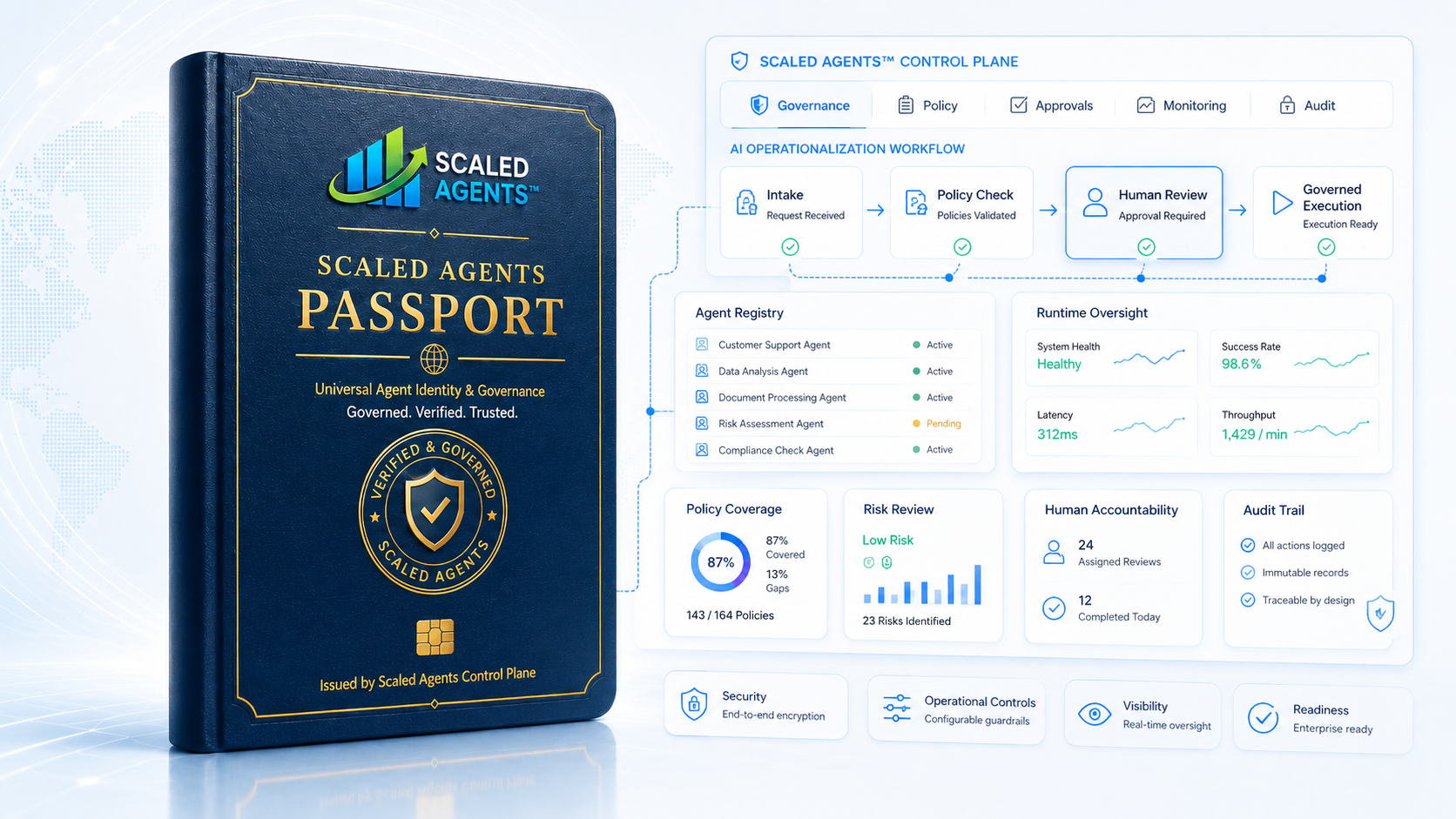
The Passport connects identity, ownership, approved scope, review evidence, Toll Gates, lifecycle posture, and report views into one reviewable operating record for AI workers.
It gives teams a structured starting point for enterprise AI operations without treating a draft record, score, or readiness view as production authorization, legal approval, compliance conclusion, security approval, or an audit opinion.
Solutions Preview
Scaled Agents™ organizes the governance problems enterprise teams face as AI agents move closer to systems, tools, data, and business workflows: who owns the worker, what it may do, what requires review, what evidence exists, and what happens before consequential action.
Structured review paths for proposed AI workers, use cases, owners, risk tiers, prerequisites, and readiness evidence.
Governance checkpoints for recording reviewed transitions, access boundaries, evidence updates, exceptions, and activity records.
A preview customer experience for viewing agent status, ownership, risk posture, Passport state, support needs, and review records.
Readiness support for control domains, evidence boundaries, external-review preparation, and human-owned launch or pause decisions.
Governed by people. Powered by agents.
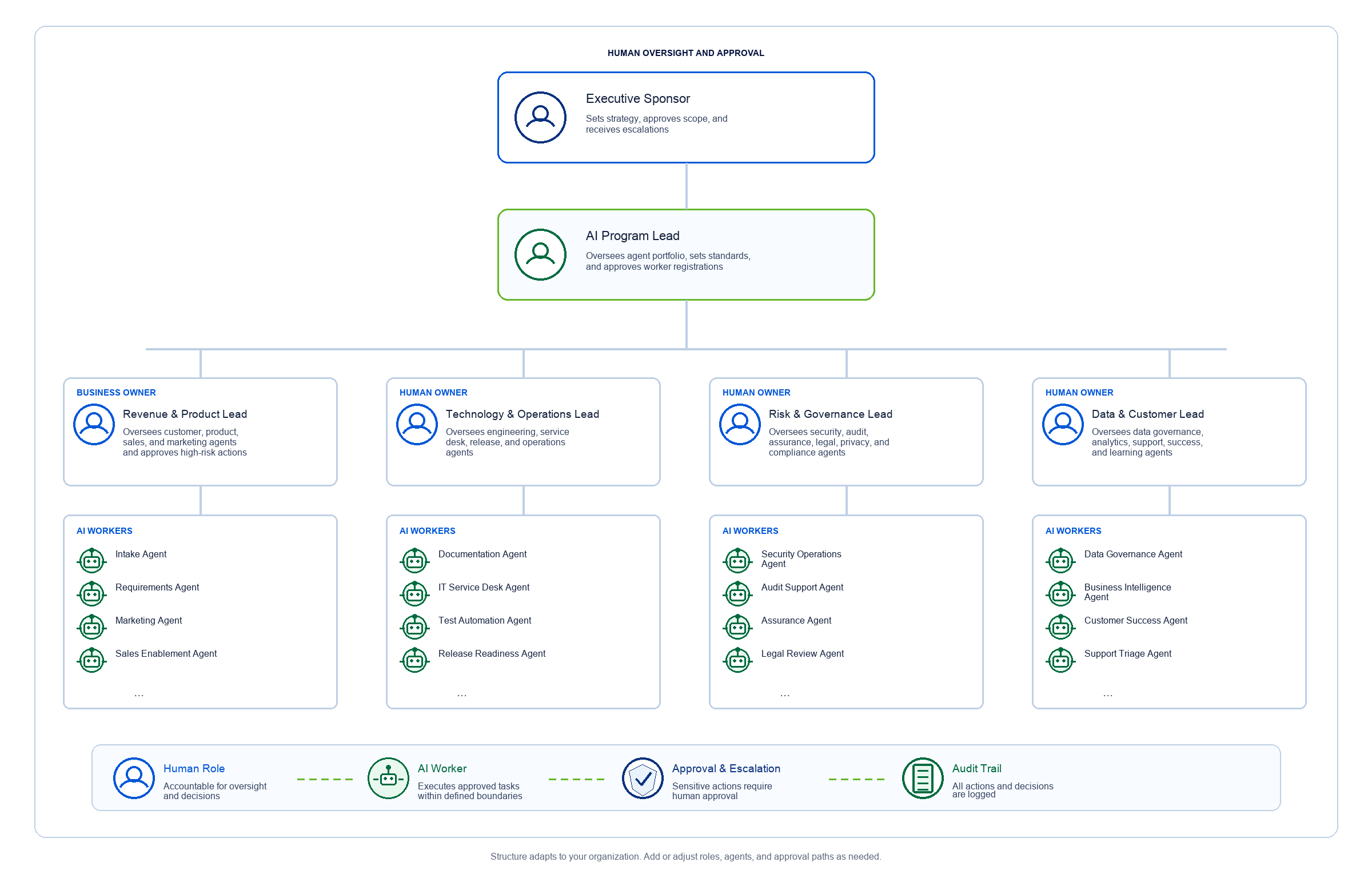
Scaled Agents™ connects AI workers to named human owners for clarity, oversight, and accountability. The structure keeps decisions traceable, boundaries respected, and human judgment in control.
Every AI worker has a human owner responsible for purpose and performance.
Humans set boundaries, review exceptions, and approve sensitive actions.
AI workers operate inside defined scope, escalation paths, and review routes.
Key decisions and activity records are prepared for review and improvement.
Featured Service
Draft planning support for business readiness, AI knowledge worker roles, human review, advisor preparation, and launch-readiness conversations before broader use.
DRAFT ONLY — CUSTOMER VERIFICATION AND PROFESSIONAL REVIEW REQUIRED BEFORE RELIANCE OR USE. AI-Powered Business Scaling Services are advisory, implementation-support, governance, and training services. AI-assisted outputs may be incomplete, inaccurate, outdated, or incorrect, and they do not promise revenue outcomes, compliance status, security credentials, audit signoff, legal conclusions, or operational success. Customers remain responsible for validation, approval, implementation, and qualified professional review where needed.
Training Paths
Most AI training teaches people how to use tools. Scaled Agents™ Training helps teams understand how to govern AI workers.
Scaled Agents™ Training provides role-based learning paths for teams preparing to govern AI workers across intake, design, review, oversight, evidence, escalation, and lifecycle management.
Training materials are being prepared for instructor-led delivery, self-paced online learning, customer enablement, and internal AI Worker QA review before publication. Each path helps teams understand AI worker governance and readiness boundaries without exposing proprietary Scaled Agents methods, scoring logic, internal workflows, or platform implementation details.
The course structure, learning paths, and certificate boundaries are defined. Course lessons, quizzes, templates, and QA review materials are currently being prepared before enrollment opens.
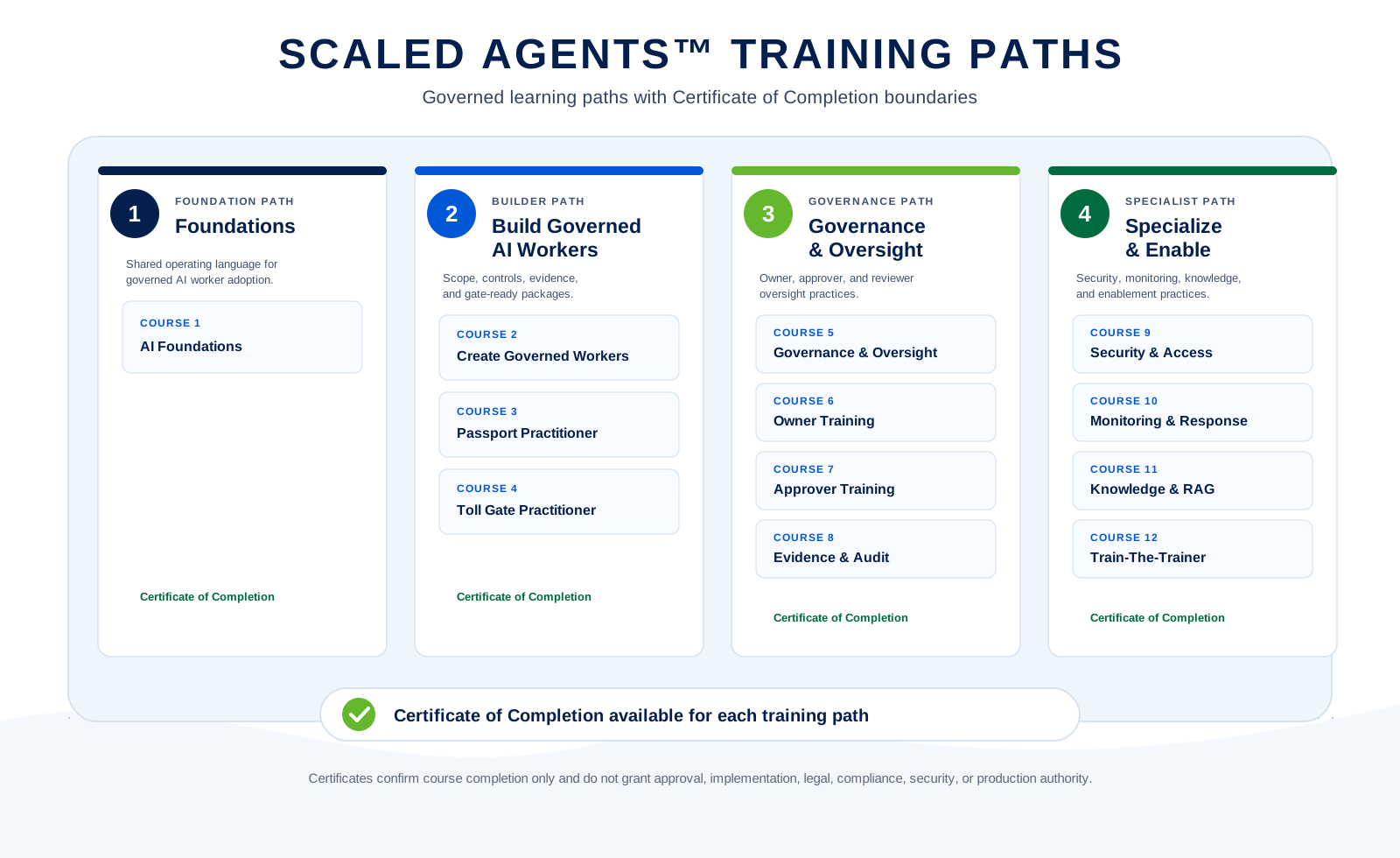
Enrollment is not open yet. Certificates of Completion will be available only after the applicable training path is published.
Self-Paced Course Paths
Each card below represents the public-facing course direction. The muted CTAs point visitors to the self-paced course preview while enrollment remains in preparation.
Foundation
For leaders, sponsors, business teams, and stakeholders who need a shared understanding of governed AI worker readiness.
Learner output: AI Worker Governance Role Map
Self-paced course previewBuild
For builders, process owners, product teams, workflow designers, and implementation teams preparing AI worker use cases.
Learner output: AI Worker Blueprint
Self-paced course previewReview
For reviewers, approvers, risk teams, compliance teams, security stakeholders, QA reviewers, and governance participants.
Learner output: Governance Review Notes and Evidence Checklist
Self-paced course previewOperate
For AI worker owners, operations teams, enablement leads, administrators, and trainers responsible for adoption and ongoing support.
Learner output: Agent Owner Operating Plan
Self-paced course previewTraining completion records may be available for each published training path. They confirm course completion only. They do not grant AI worker approval, production deployment authority, legal assurance, compliance conclusion, security conclusion, audit approval, implementation approval, or permission to operate an AI worker.
Governance & Trust
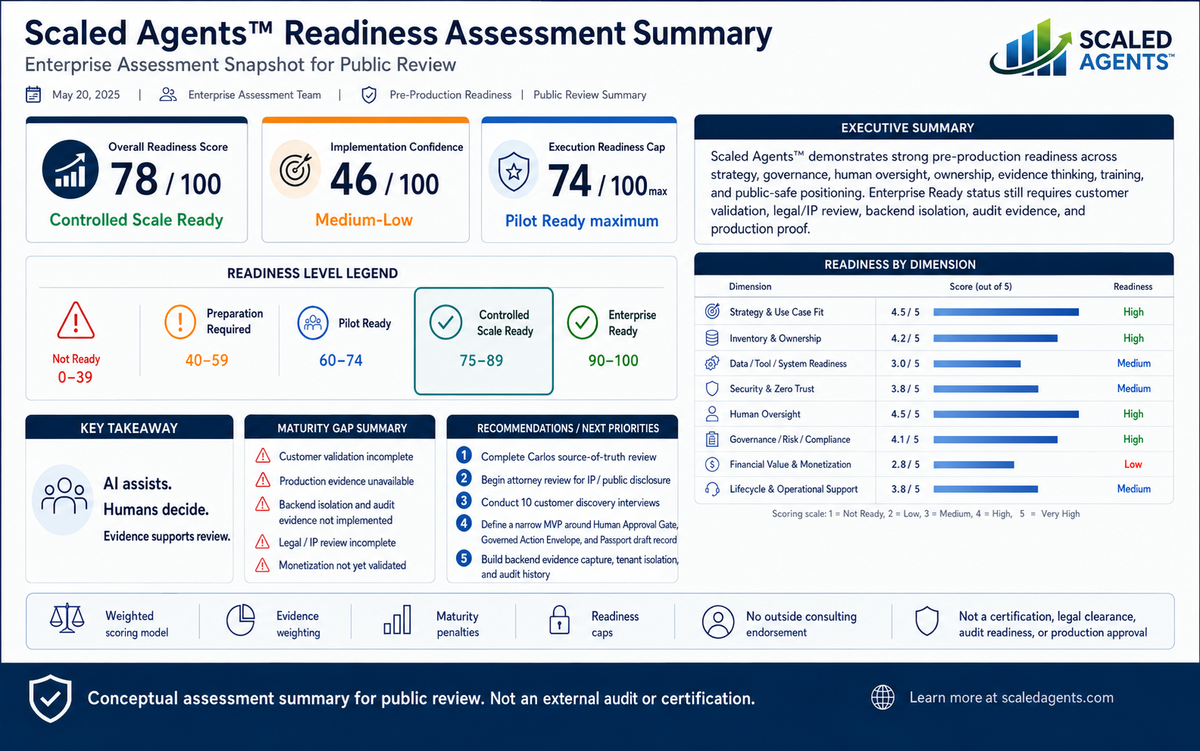
Scaled Agents™ public materials use careful readiness language. They may describe framework-informed review, human oversight, Zero Trust principles, runtime governance concepts, nonhuman identity planning, cost and usage awareness, evidence mapping, data boundary metadata, pause and containment planning, and public planning templates, but they do not claim legal, regulatory, compliance, security, audit, government, live enforcement, or production use.
Governance Public Library
The Scaled Agents™ Public Library provides public preview templates, planning worksheets, and governance-readiness resources for teams preparing AI worker ownership, evidence, human review, security readiness, and controlled launch conversations.
Who We Are
Scaled Agents™ helps teams prepare AI-supported work for governed operation by clarifying ownership, boundaries, review paths, evidence needs, and human accountability before AI workers move closer to operational use.
AI workers may assist, draft, route, recommend, validate, and execute permitted work inside reviewed boundaries. Humans remain accountable for business, legal, security, compliance, customer, and operational decisions.
Follow Scaled Agents for public updates, readiness guidance, AI worker governance ideas, and ways to interact with the Scaled Agents community.
Connect on LinkedIn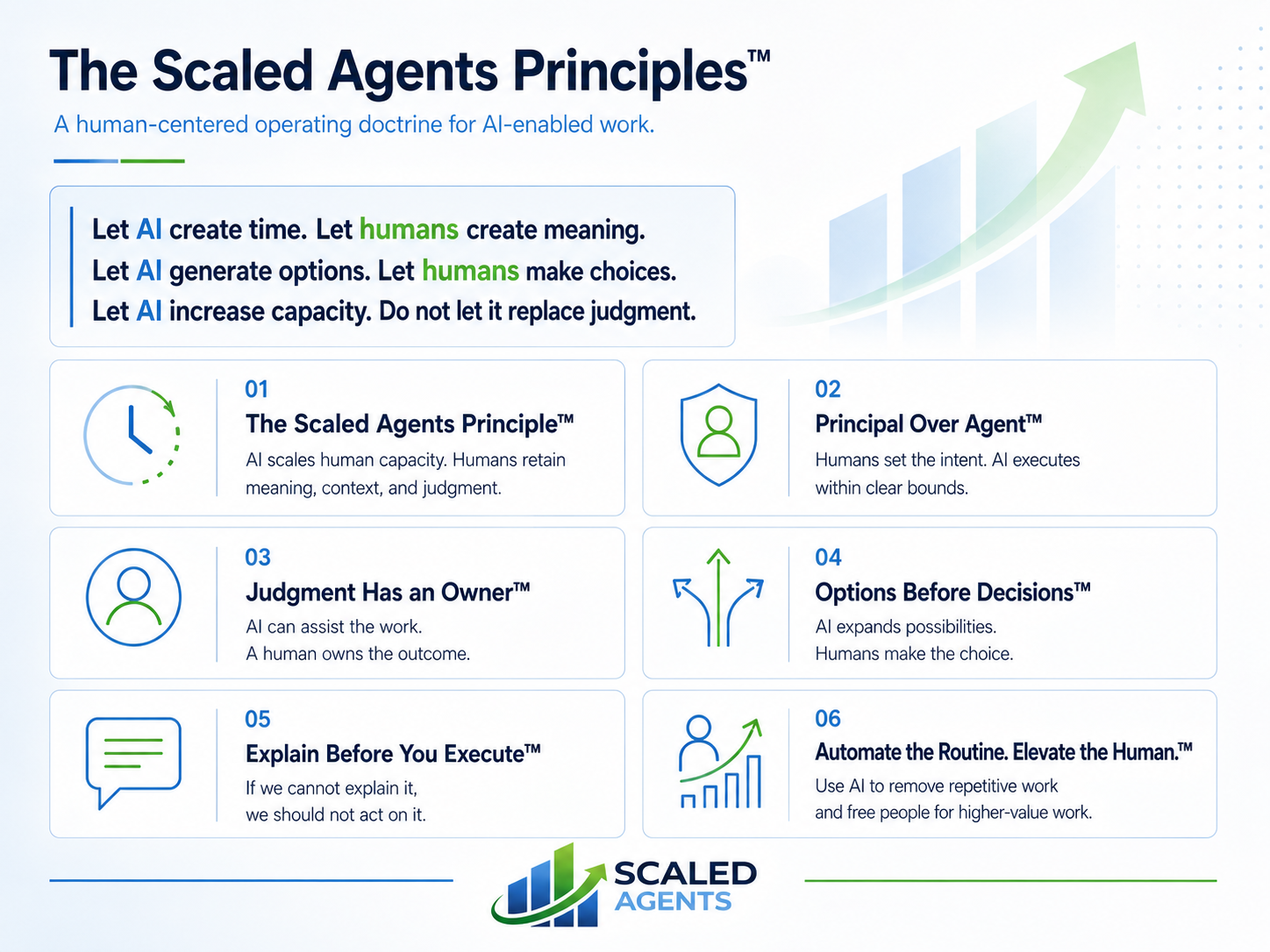
Scaled Agents keeps the operating model anchored in human accountability, governed boundaries, and reviewable evidence before AI-supported work moves closer to execution.
The deeper operating-model explanation lives on its own page, where the comparison, delivery flow, and governance boundaries have room to breathe.
Scaled Agents™ Advisor
Use the Scaled Agents™ Advisor to explore AI worker governance, readiness questions, service planning, and practical next steps before a formal review.
Forward-Deployed AI
Use Scaled Agents™ Forward-Deployed AI to explore how business problems, workflow discovery, controls, reusable templates, and approval paths can move governed AI services from concept to controlled execution.
Engagement Path
Scaled Agents™ begins with a controlled, high-level discussion before any customer data, portal access, implementation work, or reliance on draft outputs. The goal is to understand the AI worker opportunity, the human accountability model, and the review boundaries before recommending next steps.
Share authorized, high-level planning context about the AI worker, business workflow, governance concern, or service-readiness need.
Clarify owners, intended use, data sensitivity, approval needs, lifecycle state, and whether the work belongs in platform readiness, service planning, or both.
Identify the evidence, human review points, access boundaries, training needs, and professional-review dependencies before consequential use.
Prepare a practical next-step path for governance readiness, Passport planning, Toll Gate concepts, training, or AI-powered service support.
Form 1: Consultation Request
Scaled Agents™ uses a two-step consultation process: submit a quick request first, then Scaled Agents reviews the request and follows up on the right consultation path.
Step 1: Share high-level, authorized contact details and a short description of what you want to discuss.
Step 2: After Form 1 is received, the page provides the next intake link so you can share additional planning context before the consultation.
Please share only authorized, high-level planning information. Do not include passwords, credentials, API keys, production secrets, regulated data, or confidential third-party material.