Portfolio decision
Which AI workers should be shaped, funded, governed, scaled, paused, merged, or retired?

AI Worker Portfolio Management
Choose what enters. Control what advances. Measure what earns reinvestment.
Scaled Agents connects portfolio decisions to customer-owned identity, authority, delivery controls, evidence, value, and lifecycle state.
Context
This operating model connects product, portfolio, and delivery decisions to the governance records that determine whether an AI worker can advance.
Which AI workers should be shaped, funded, governed, scaled, paused, merged, or retired?
Accountable customer owners retain funding, activation, legal, privacy, security, compliance, audit, and risk decisions.
The Challenge
Delivery tools can track tasks. They do not establish who owns an AI worker, what it may do, what evidence it needs, or whether continued investment is justified.
Teams fund overlapping agents, tools, data paths, and review work without a shared portfolio view.
Ownership, permissions, sensitive-data boundaries, and human-review requirements drift away from delivery plans.
Model, cloud, workflow, and support costs grow without comparable evidence for adoption, quality, or business outcomes.
The portfolio question is not “How many agents can we launch?” It is “Which governed AI workers deserve authority and continued investment?”
Core Architecture
Each decision keeps business value connected to the customer-owned governance chain.
Define the business outcome, intended users, owner, data, systems, autonomy, and measurable value before funding delivery.
Compare strategic fit, cost, risk, reuse, dependencies, and evidence needs across proposed and active AI workers.
Bind the work to Passport scope, Toll Gates, Human Review, approved tools, delivery gates, and accountable handoffs.
Use operating evidence to scale, improve, pause, merge, revoke, retire, or reinvest.
Core Differentiator
A Passport connects an AI worker’s human owner, purpose, scope, permissions, risk, evidence, cost, value, and lifecycle state.
Registration makes the AI worker visible. It does not approve funding, grant runtime authority, or replace the exact Toll Gate, Human Review, Runtime Permit, and Action Broker decision required for consequential action.
Lifecycle Flow
A funded or delivered AI worker is not automatically authorized to act. Each lifecycle stage carries its own decision, evidence, and rollback boundary.
Tools & Platform Layer
Existing product, project, cloud, model, and financial systems remain useful inputs. Scaled Agents preserves the customer-owned governance chain across them.
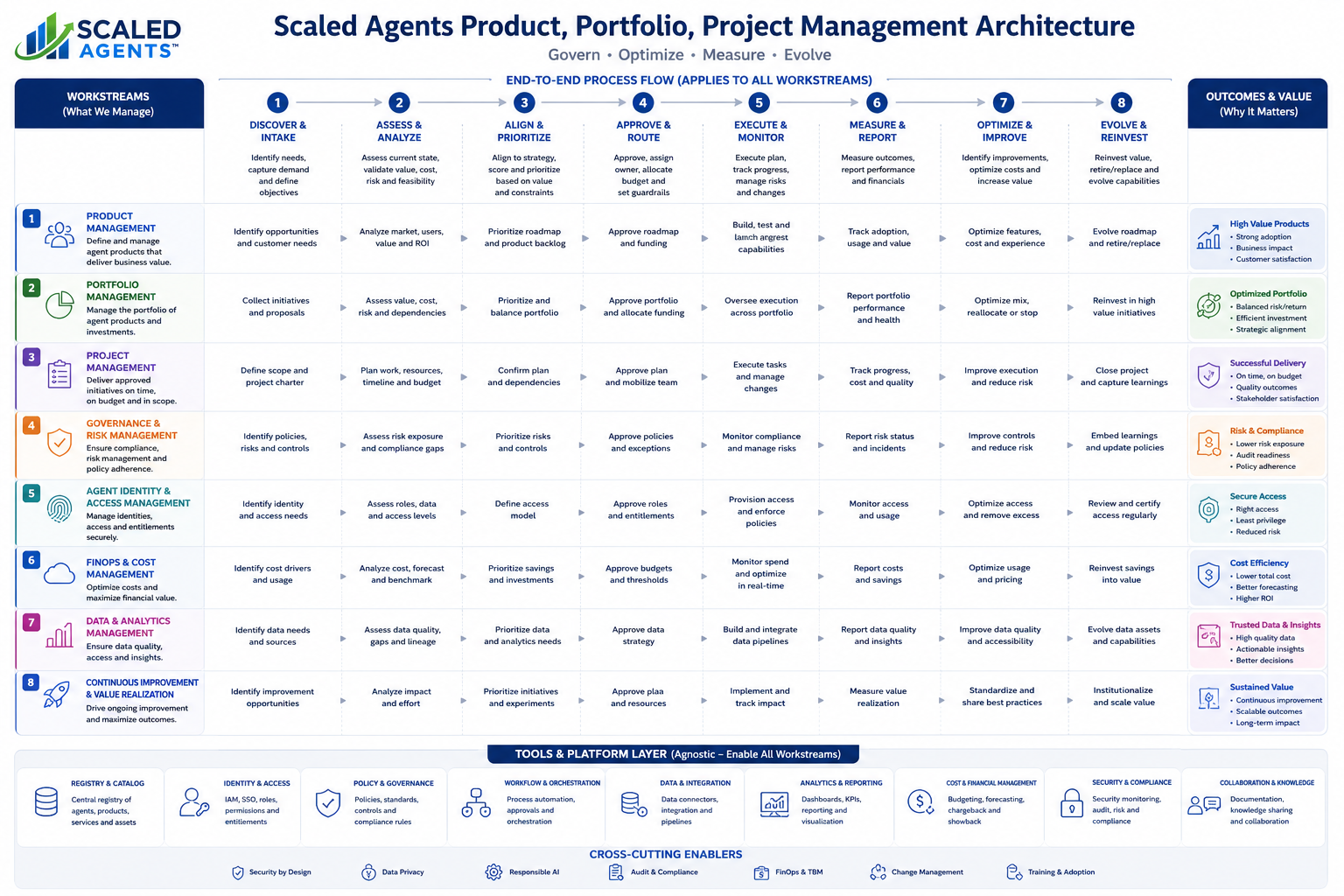
Agent Registry, Passport, Purpose Binding, and Tool/API/Connector Registry establish ownership and eligible scope.
Toll Gates and Human Review inform a short-lived Runtime Permit; the Action Broker mediates the exact action.
Evidence Records, Stamps, Workflow Events, and Audit Export Packages support reconstruction, monitoring, renewal, and retirement.
Value Outcomes
The objective is not a larger agent count. It is clearer evidence for where the customer should invest, constrain, improve, or exit.
Find overlapping demand, duplicated capabilities, and repeated platform or review cost.
Direct funding toward AI workers with current ownership, governed authority, adoption, quality, and value evidence.
Pause, narrow, merge, revoke, or retire work when risk, cost, control gaps, or weak outcomes no longer justify continuation.
Illustrative savings or ROI ranges must be validated against each customer environment. This page does not guarantee financial outcomes, risk reduction, compliance status, audit results, or production approval.
Closing Principle
Create the Blueprint, name the owners, define the intended outcome and authority boundary, then route the work into the existing customer-managed control plane.